
Complex Pricing, Fast Proposals: A Custom Proposals Application Case Study
By Panos Kontopoulos ·

Industry: Medical equipment distribution Stack: React, TypeScript, Supabase, Vercel · Timeline: Brief to production in under 8 weeks Outcome: A custom proposal platform that builds, versions, and exports complex multi-product offers in minutes.
A leading distributor of specialized medical equipment came to us with a capable, motivated sales team and a process that wasn't keeping up with them.
Proposals were assembled by hand in spreadsheets, then formatted into PDFs for clients. It worked — but it took time, small errors slipped through, and there was no easy way to keep track of which version of an offer had gone to which client. When someone needed last month's revised proposal, it usually meant searching back through email.
They didn't need a generic CRM. They needed something built exactly for how they work.
The Problem With Generic Tools
Most sales software assumes your business works like everyone else's. You have a product. A customer. A price. Done.
This client's reality is more complex. Their proposals cover specialized medical equipment — each offer can span dozens of products, organized into logical groups (equipment, accessories, consumables), with per-product discounts, cascading discount tiers, and VAT calculations that need to be exactly right. A service proposal might include photos of previous installations to demonstrate quality.
Off-the-shelf tools either couldn't model this structure, or required so much customization that you'd end up paying enterprise prices for a system that still didn't quite fit.
The ask was clear: build something that works the way the team already works — just faster, cleaner, and with far less room for error.
What We Needed to Solve
Before writing a single line of code, we mapped the real pain points:
Proposal structure. Offers needed to be organized in groups, each with independent ordering, pricing, and discounts per line item — with drag-and-drop sequencing, batch product entry, and reusable saved "sets" for recurring configurations.
Version control. When a client asks for a revision, the original has to stay intact while a new version inherits everything from it.
Export flexibility. Different situations call for different formats — a formal client-facing PDF, an editable document for annotation, and a clean spreadsheet to push order data straight into the client's ERP once a deal is won.
Master data at scale. The product catalog runs to thousands of SKUs, with customer and delivery records maintained in an ERP that needs to sync reliably.
Mobile readiness. Sales reps don't always sit at a desk. The entire application had to work on a tablet without compromise.
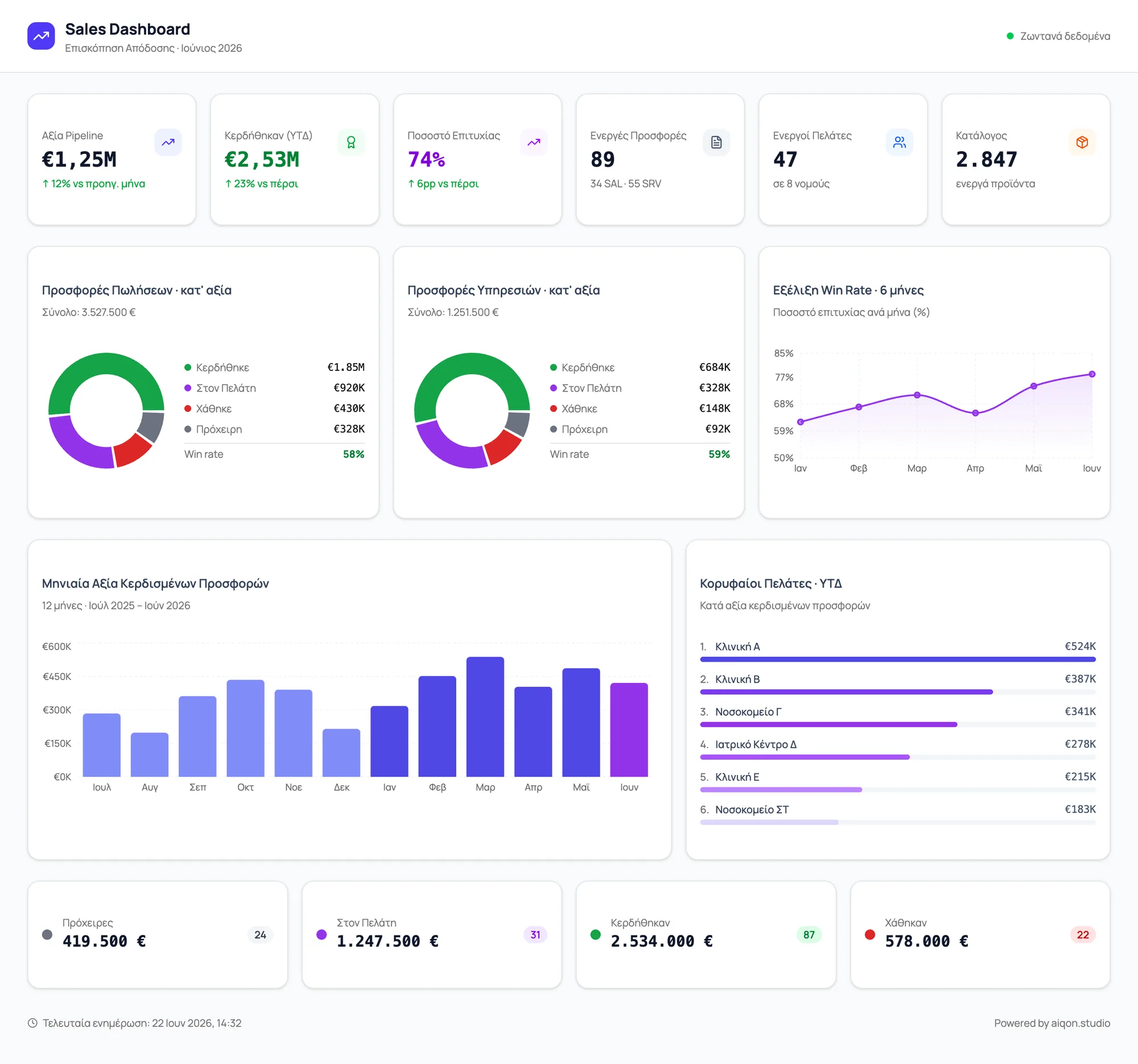
The Decisions That Made the Difference
A few choices had outsized impact on the outcome — and each one came down to the same principle: fit the team, avoid unnecessary complexity.
Excel as the import interface. Rather than build admin screens for thousands of products and customers, we leaned into the format the client's team already uses. Administrators upload an Excel file; the system deactivates the old records and brings in the new ones. It's fast, it's auditable, and it requires zero training.
Instant document generation. PDF, editable-document, and spreadsheet exports all happen right in the browser — no server pipeline, no queue, no waiting. Click the button, get the file in seconds. For the PDF, we made sure Greek characters render perfectly across every device.
Versioning built in from day one. Each revision is an independent record linked by a shared proposal code, with the previous version automatically marked "superseded." Reps can browse the full history from a single icon.
How We Built It — and How Fast
The entire platform went from brief to production in under eight weeks.
This is where AI-assisted development fundamentally changes the economics. Complex features that used to eat whole sprints — Greek-language PDF rendering, in-browser document generation, drag-and-drop reordering, real-time discount-cascade calculations — were built, tested, and shipped in a fraction of the time they'd have taken even two years ago.
The proposal engine alone has real depth: four independent discount fields that stack sequentially, VAT calculated on the net result, a live totals panel that updates as the user types. In the past you'd spend a sprint just on that. We shipped it alongside ten other features in the same week.
For the technically curious: the platform runs on React, TypeScript, Supabase (PostgreSQL + Storage), and Vercel, with UI components from shadcn/ui — a fast, maintainable codebase by design.
What the Team Can Do Now
The shift in day-to-day experience is concrete.
A rep opens the app, selects a customer and delivery address, and starts building. They add forty products in thirty seconds using batch input or a saved set. They apply a customer discount with one click — it cascades across every line item. They write the terms, hit submit, and a professional, consistently formatted PDF is ready for the client in well under a minute.
When the client asks for a revision? Two clicks to create v2. The original is preserved exactly as it was sent.
When the proposal is won? Export a spreadsheet straight into the ERP, close the record, move on.
And here's the part that pays off later: every rejected proposal requires a loss reason before it can be closed. Over time, that turns into a pattern. Are you losing on price? On delivery time? To a specific competitor? The system is quietly building that intelligence for you — even before anyone runs the analysis.
The Business Case for Custom
This project is a clean illustration of a pattern we see again and again: the cost of not having the right tool is invisible until you build it.
Nobody was measuring how long it took to assemble a proposal in Excel, format it, email it, track the response in a shared spreadsheet, and redo all of it when the client came back with changes. It just felt like "how sales works."
Replace that with a system that does the same job in minutes instead of hours — for every proposal, every version, every export — and the math adds up fast. And with AI-assisted development compressing build timelines compared to traditional approaches, the investment to get there is smaller than most teams expect.
Custom doesn't mean expensive anymore. It means it fits.
Let's Talk
If your sales team is building proposals in Excel, wrestling with inconsistent PDFs, or losing track of which version went to which client — this is a solvable problem. The tools exist. The timeline is realistic. The ROI is measurable.
Email us at info@aiqon.studio and we'll walk you through what a system like this could look like for your team.